
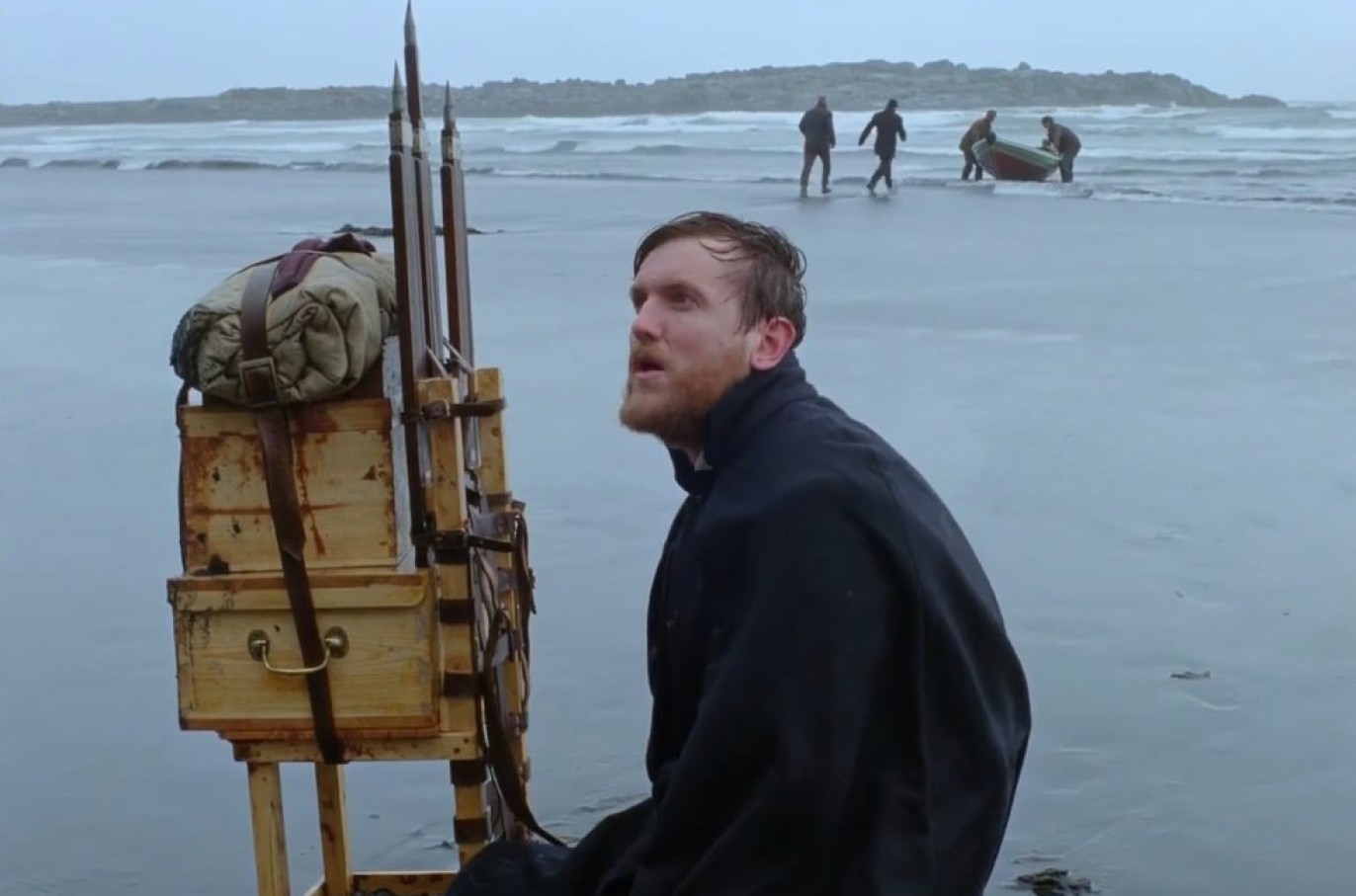
“Godland” (2022) – “The island is very different from Denmark. People there…the weather, the winter, everything is different.”
In the late 19th century, an experienced Danish man of the cloth (Waage Sando) delegates an assignment to his young, pious subordinate, Lucas (Elliott Crosset Hove). Lucas, a late 20-something or 30-something priest, is willing to please Vincent (Sando), or perhaps, he doesn’t have the will to reject his mentor’s wishes. Regardless, the said task is an intimidating one: travel to Iceland, hike across endless kilometers of desolate prairies, mountains, and rivers, and establish a church.
To help record the events, Lucas carries along his camera. However, at the time, such an instrument resembles a hefty wood and steel desk with an accompanying cape, so he’s forced to lug it around like a mammoth, awkward appendage. He also has one additional ask: a three-meter-long crucifix must also be transported to the eventual destination.
It’s never spoken out loud, but Lucas – a slim, slight man – looks and acts like he’s never camped in his life – not even an overnight – let alone hiked across an unforgiving countryside for weeks on end. We quickly gather that this untested explorer hasn’t mounted or ridden a horse, judging by the awkward meeting between the man and a four-legged mammal early in the first act.
Thankfully, Vincent ensures that Lucas and a translator (Hilmar Gudjonsson) have capable trackers to guide the young Danes on their journey. A burly, experienced escort named Ragnar (Ingvar Sigurdsson) leads this trek with pragmatic intentions in director/writer Hlynur Palmason’s (“A White, White Day” (2019)) searing cinematic epic.
Palmason fashions the Icelandic landscape as a mystical and intimidating character for the audience and Lucas, and the clergyman also carries lofty emotional makeup during frequent collisions with Ragnar and other locals.

The palatable tension between Lucas and Ragnar is real, and not only because of the city-mouse-country-mouse dynamic. Iceland was part of Denmark’s kingdom then, and Palmason suggests a complicated relationship between the two populaces.
In fact, Hlynur was born in Iceland but lived for a time in Denmark.
In a May 26, 2022 Scandinavian Films interview, Palmason says, “I wanted to make a film that worked with the history that (Iceland and Denmark) have together, which is rich.”
However, resentment can sometimes brew among people ruled by another nation. As a professional, Ragnar provides a safe environment – as best he can against the elements – for Lucas. Still, it isn’t easy to imagine that any sort of friendship will bear fruit.
Ragnar’s stoic body language communicates animosity, and at one point, he mutters under his breath, “Danish devil.”
Not only does Lucas face an overwhelming challenge on a grand scale, but he must confront friction within the traveling party, admittedly, some created by his own doing.
Clocking in at 138 minutes, Palmason channels his inner Werner Herzog or Terrence Malick in this instant classic, a film that should garner multiple Oscar nominations – including Best Picture, Cinematography, Director, and Supporting Actor (Sigurdsson) – as the story strikingly conveys the lasting, unforgiving power of Mother Earth as well as humanity’s fragility, both physically and psychologically.
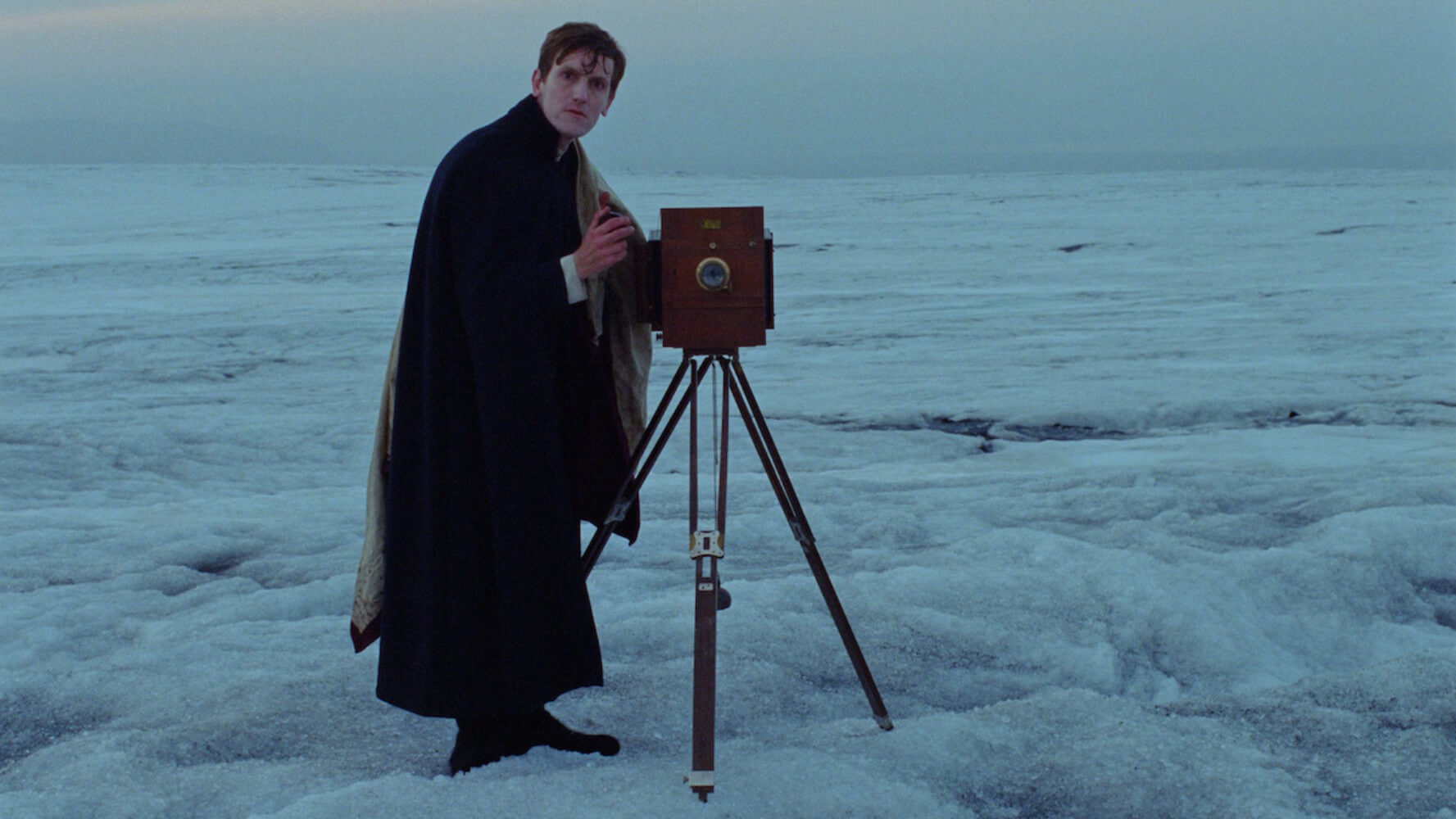
“Godland” is a towering achievement, one that pits naivety against nature, proficiency, and an established society in a daunting, immersing time warp.
From a purely visual perspective, Palmason and cinematographer Maria von Hausswolff – Hlynur’s long-time collaborator since 2013 – capture Iceland’s rustic setting – a place sought for its otherworldly beauty – as Ragnar, Lucas, and the small band of horses and other men traverse across the astonishing terrain of lonely browns and greens under ever-present gray skies.
Sometimes Palmason and von Hausswolff position their camera within a few meters from their subjects. Other times, they place it way off in the distance as they expose the triviality of man striding across the alien expanse. Filmed with a 4:3 ratio, the squared appearance assists in the illusion that the filmmakers are peering into a historical, pastoral era through a magical telescope. Curiously, the strenuous march usually moves past the lens (or the lens strides along with the players) from left to right, which signals the troupe’s progress.
However, Lucas’ internal direction regresses due to the ongoing stress of the seemingly never-ending tour, or maybe his rising anxiety reveals his true character that lies below.
Do the travelers find their hopeful destination? Well, Hlynur divides his movie into two distinct portions, one that encounters the environment and another that greets a community, and both present inherent hazards when one wanders over boundaries.
⭐⭐⭐⭐ out of ⭐⭐⭐⭐
Directed and written by: Hlynur Palmason
Starring: Elliott Crosset Hove, Ingvar Sigurdsson, Hilmar Gudjonsson, Waage Sando, Vic Carmen Sonne, and Jacob Lohmann
Runtime: 138 minutes
Image credits: Scanbox, Snowglobe Films


